


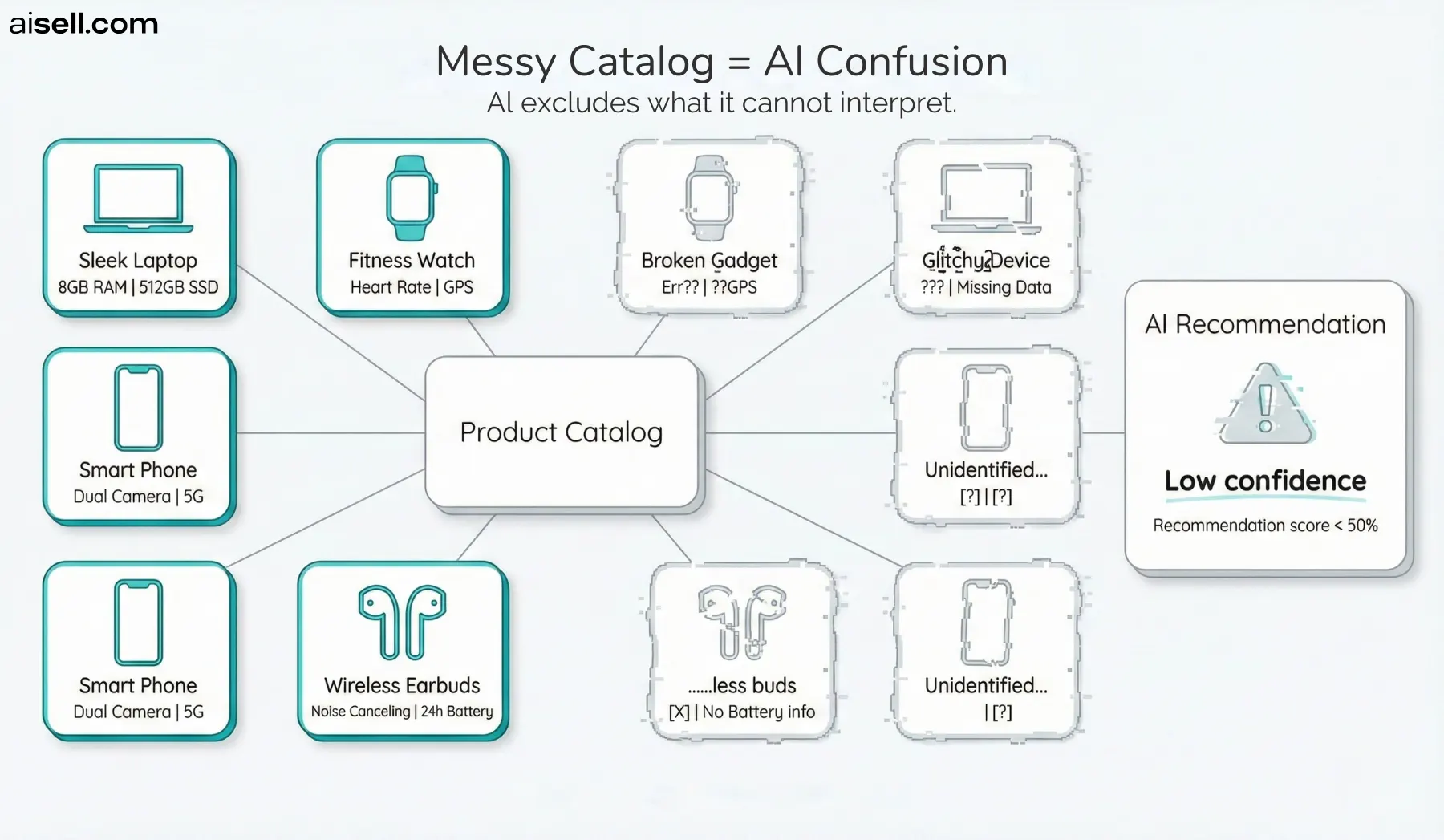
What “Messy” Means in AI Commerce
Most ecommerce teams underestimate how messy their catalog really is.
From a human perspective, a catalog might feel usable. From an AI perspective, the same catalog can be unreadable.
Messy Does Not Mean Incomplete Only
In AI commerce, a catalog is considered messy when it has:
- inconsistent product definitions
- missing or partially filled attributes
- duplicated or overlapping listings
- unclear variation logic
- contradictory descriptions
- mismatched titles and attributes
- fragmented bundles and kits
Humans can often infer meaning from context.
AI cannot.
AI relies on explicit structure.
If the structure is broken, interpretation fails.
Why Search Could Tolerate Messy Data
Traditional ecommerce search systems are forgiving.
They match keywords. They rank broadly. They allow humans to decide.
Messy catalogs still worked because:
- keywords could compensate for missing structure
- ads could buy visibility
- users could manually compare products
AI systems remove those buffers.
They need clean inputs to produce confident outputs.
Why AI Systems Fail on Messy Catalogs
AI-driven commerce systems operate differently than search engines.
Their goal is not to show many options.
Their goal is to recommend a few safe ones.
To do that, AI systems must answer three questions:
- what is this product
- how is it different from similar products
- is it safe to recommend
Messy catalogs fail at all three.
Ambiguity Breaks AI Confidence
When product data is inconsistent, AI cannot build a stable internal representation.
Examples:
- title says one thing, attributes say another
- variants overlap but are not connected
- sizes are described differently across listings
- compatibility is implied but not structured
This creates ambiguity.
AI systems respond to ambiguity by lowering confidence.
Lower confidence leads to exclusion.
Duplicates Are a Visibility Killer
Duplicate or near-duplicate products are especially dangerous in AI commerce.
To an AI system, duplicates look like:
- uncertainty about the “real” product
- lack of authoritative definition
- risk of recommending the wrong option
Instead of choosing one, AI often avoids all of them.
This is why sellers with many similar SKUs often lose visibility first.
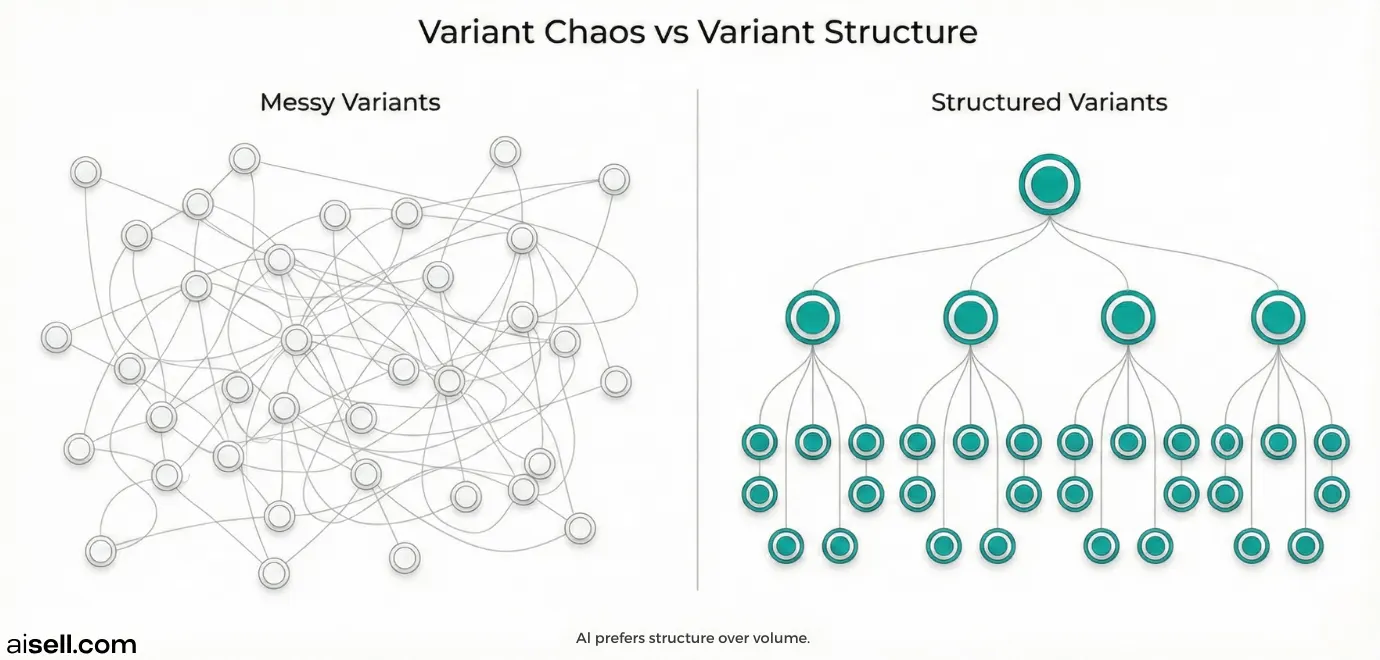
Variations Without Logic Are AI Poison
Variations are supposed to simplify choice.
Messy variation structures do the opposite.
Common problems:
- multiple parents for the same product
- incorrect variation themes
- missing attributes per child
- inconsistent naming between variants
Humans might still understand this.
AI does not.
If the AI cannot explain the difference between variants, it will not recommend them.
How Messy Catalogs Reduce AI Visibility
The biggest misconception is that messy catalogs perform worse.
The reality is harsher.
Messy catalogs often do not perform at all in AI-driven discovery.
AI Filters Before Ranking
In AI commerce, filtering happens before ranking.
Products are first evaluated for:
- data completeness
- structural consistency
- trust signals
- operational reliability
Only then are they compared.
If a product fails early evaluation, ranking never happens.
That means sellers can lose visibility without any visible ranking drop.
Why Sellers “Disappear” Without Noticing
Many sellers will notice:
- stable rankings
- normal traffic from ads
- decent conversion rates
But organic discovery slowly declines.
Why?
Because AI assistants stop surfacing their products in:
- recommendations
- guided shopping flows
- comparison answers
- shortlist experiences
This loss is invisible in classic dashboards.
Structured Data Is the Language of AI Commerce
AI systems do not reason in prose.
They reason in structure.
Attributes, relationships, hierarchies, and consistency matter more than persuasive copy.
If your catalog is not structured, it is not readable.
And unreadable products cannot be recommended.

How to Fix a Messy Catalog for AI Commerce
Fixing catalog mess is not glamorous.
But it is one of the highest leverage moves in AI commerce.
Step 1: Define Products Clearly
Every product should have:
- a single clear definition
- a clear use case
- a clear differentiation
If two listings describe the same thing, consolidate them.
AI prefers one strong definition over many weak ones.
Step 2: Normalize Attributes
Attributes must be:
- complete
- consistent
- standardized across similar products
The same attribute should not be described three different ways.
Consistency increases AI confidence.
Step 3: Clean Variation Logic
Each variation should answer one question:
“How is this option different?”
If that answer is unclear, restructure.
Clean parent child relationships improve AI interpretation.
Step 4: Remove Duplicates and Overlaps
Duplicates confuse AI systems.
If products overlap heavily, merge them or clearly differentiate them.
Ambiguity reduces eligibility.
Step 5: Treat Catalog Hygiene as Strategy
Catalog cleanup is not a one-time project.
It should be:
- monitored
- audited
- continuously improved
In AI commerce, catalog hygiene is not operational overhead.
It is a visibility strategy.
Key Takeaways
Messy product catalogs were survivable in traditional ecommerce.
They are fatal in AI commerce.
AI systems avoid ambiguity, inconsistency, and unclear structure.
Products with messy data do not rank lower. They are excluded.
Brands that clean up their catalogs gain a structural advantage that competitors cannot easily copy.
In the AI era, clarity is not optimization.
It is survival.