

What Product Attributes Actually Are
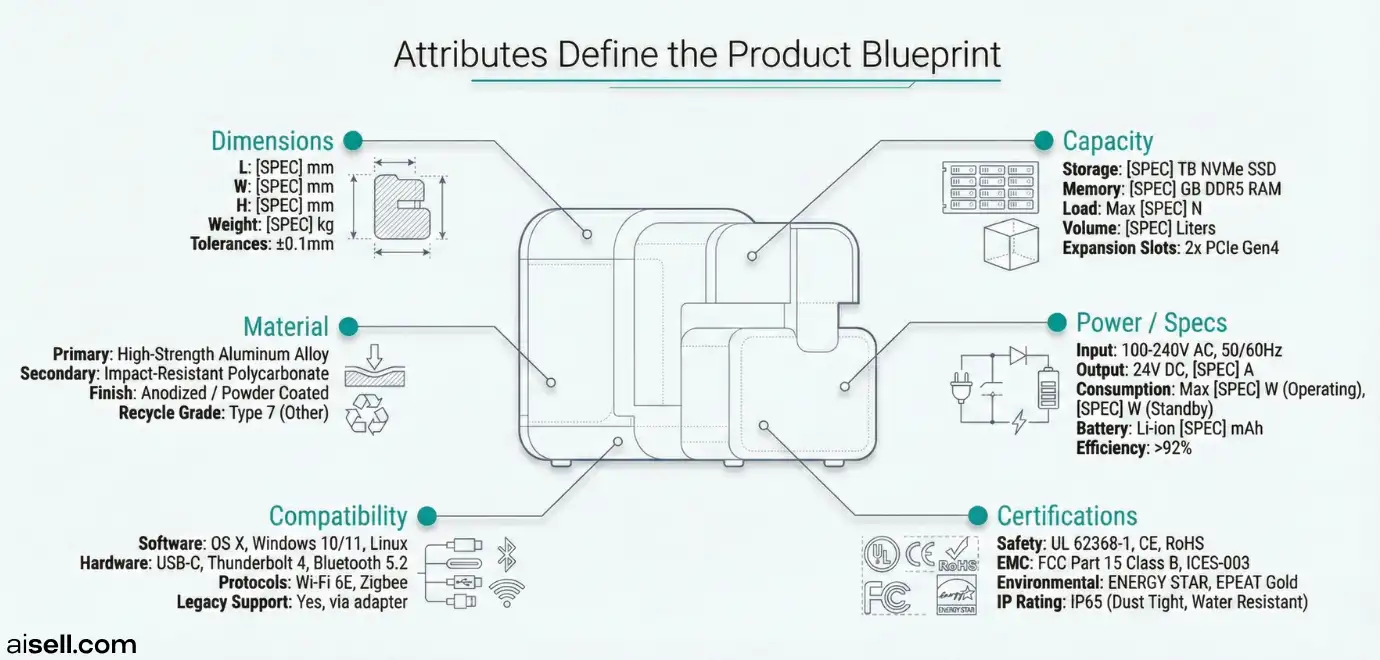
Product attributes are structured fields that describe a product in a consistent, machine-readable way.
They are not marketing content.
They are not persuasion.
They are factual descriptors such as:
- material
- size
- weight
- color
- compatibility
- model number
- power type
- certifications
- capacity
- included components
Attributes create a standardized product profile that systems can interpret.
Attributes vs Product Description
Many sellers assume their product description is enough.
But AI assistants do not rely on paragraphs to compare products.
They rely on structured values.
A description can say:
“This laptop stand is perfect for MacBooks and improves posture.”
But an attribute can say:
Compatible devices: MacBook Pro 13, MacBook Air 15
The attribute is usable.
The description is vague.
Attributes Are Not Optional in AI Commerce
In AI commerce, attributes are not “extra”.
They are the minimum requirement for AI evaluation.
AI systems need them to answer basic customer questions:
- does this fit
- does this work with my device
- is this the right size
- is this safe
- is this better than alternatives
If the attributes are missing, the AI cannot answer confidently.
And if it cannot answer confidently, it avoids recommending.

Why AI Depends on Structured Data
AI commerce is driven by selection.
Selection requires comparison.
Comparison requires structure.
That is the chain.
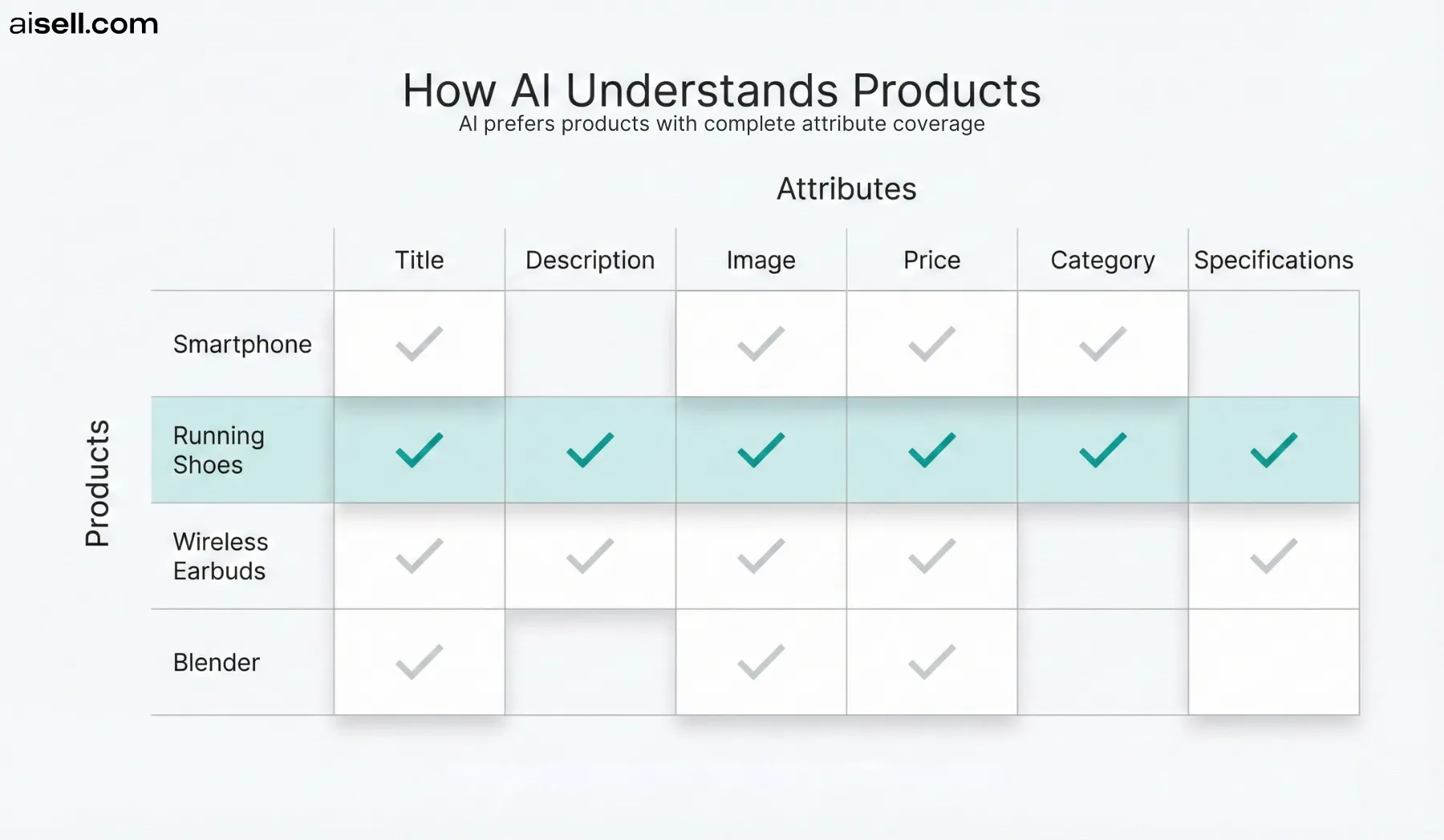
AI assistants can only recommend products when they can compare them across consistent dimensions.
AI Needs Attributes to Filter Products
In traditional search, users filter manually.
In AI commerce, the AI filters automatically.
That means AI must have structured filters such as:
- size range
- compatibility list
- material type
- capacity
- durability signals
- certifications
Without attributes, filtering becomes guessing.
AI avoids guessing.
Attributes Enable “Reasoning” in AI Commerce
When an AI assistant recommends a product, it must justify the recommendation.
Example:
“This is the best option because it supports USB-C, fits 13-inch laptops, and has strong reviews for stability.”
Those details often come from structured fields.
If the AI cannot find structured proof, it cannot justify.
And if it cannot justify, it does not recommend.
Attributes Reduce Risk
AI systems are risk-averse.
They avoid recommending products that could cause:
- returns
- wrong fit
- compatibility failures
- customer frustration
Attributes reduce risk because they define product constraints.
If a product is missing compatibility attributes, it becomes a risk.
AI avoids risk.
The Most Common Attribute Mistakes Sellers Make
Attributes are powerful, but most catalogs contain mistakes that quietly destroy AI visibility.
1. Missing Attributes
The simplest failure.
If a product is missing key attributes, it becomes incomplete.
Examples:
- shoes without width
- electronics without compatibility
- furniture without dimensions
- supplements without ingredient details
- chargers without wattage
Missing attributes reduce AI confidence.
2. Inconsistent Attribute Formats
This is even worse than missing values.
Examples:
- “10 in” vs “10 inch” vs “10 inches”
- “USB C” vs “USB-C” vs “Type C”
- “Grey” vs “Gray”
- metric vs imperial mixed randomly
Humans can interpret these.
AI systems treat them as inconsistent signals.
3. Wrong Attributes
Many sellers fill attributes incorrectly to appear in more searches.
This might help short-term indexing, but it destroys AI trust.
If the title says “Stainless steel bottle” and the attribute says “Plastic”, the AI does not know which one is true.
Contradictions reduce confidence.
4. Overloading Attributes With Marketing Claims
Attributes are not the place for hype.
“Best quality premium luxury design” is not an attribute.
AI needs measurable values.
If attributes contain marketing fluff, they become unusable.
5. Variant Attributes Not Aligned
Variants often break catalogs.
Example:
Parent listing says “T-shirt”, but children use inconsistent size naming.
Or colors are listed differently across variants.
AI assistants struggle to explain variant differences when the attributes are not aligned.
This is why variant hygiene is one of the strongest AI visibility factors.
How to Optimize Attributes for AI Commerce in 2026
If you want to improve AI visibility, attribute optimization should become a core process.
Not a one-time fix.
Step 1: Identify Your “AI Critical Attributes”
Not all attributes matter equally.
AI critical attributes are the ones that directly affect:
- compatibility
- fit
- safety
- comparison
- performance
Examples:
- device compatibility
- dimensions
- power output
- ingredient list
- material type
- certifications
These attributes should be treated like mandatory fields.
Step 2: Standardize Formatting Rules
Define rules for:
- units
- spelling
- capitalization
- value types
- allowed attribute options
Consistency is more important than “perfect wording”.
Step 3: Validate Attributes Against Titles and Descriptions
Attributes must match the product definition.
If the listing says one thing and the attribute says another, AI trust collapses.
Build validation checks.
Step 4: Fix Variants First
If your catalog has variants, optimize them first.
A clean variation structure makes AI interpretation dramatically easier.
Step 5: Treat Attributes as a Visibility Strategy
In AI commerce, attributes are not operational work.
They are strategic.
They determine whether AI systems can recommend your product.
Sellers who invest in structured data will gain a durable advantage because competitors cannot copy structure quickly.
Key Takeaways
Product attributes are becoming one of the most important inputs for AI commerce.
AI assistants depend on structured data to filter, compare, and recommend products.
Missing or inconsistent attributes reduce AI confidence and remove products from AI-driven visibility.
In 2026, sellers should treat attribute optimization as a core growth lever, not a compliance task.
In AI commerce, structured data is visibility.