

What Is Amazon Rufus?
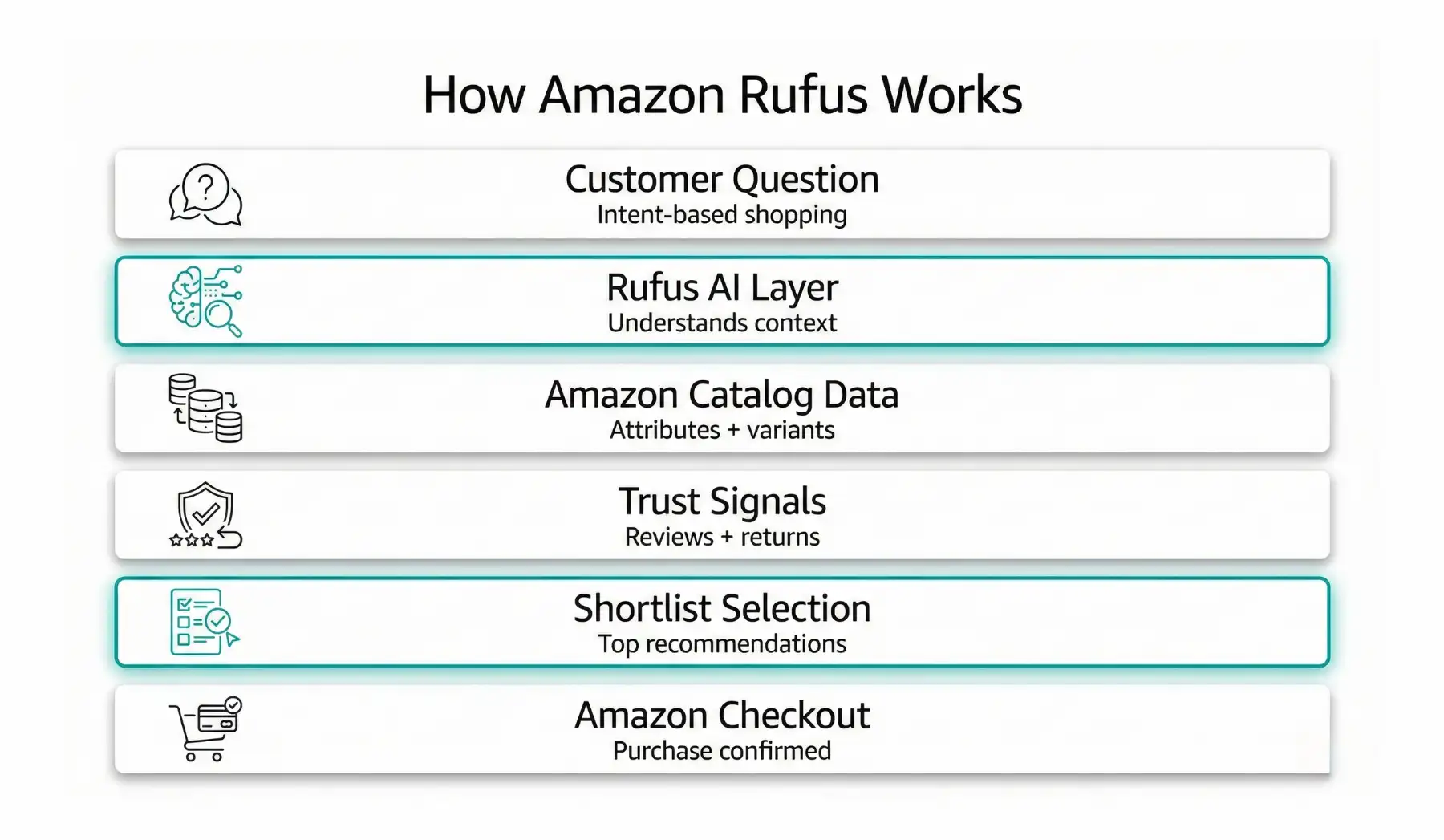
Amazon Rufus is an AI-powered shopping assistant built into the Amazon shopping experience. It allows customers to ask questions about products and receive answers that summarize information across Amazon’s catalog.
Instead of searching using keywords, shoppers can ask:
- what is the best option for a specific use case
- which product is compatible with their needs
- what customers say about certain features
- how products compare across price and quality
Rufus is designed to reduce friction. It helps customers make decisions faster.
For Amazon, Rufus increases conversion and reduces buyer hesitation.
For sellers, Rufus introduces a new visibility layer that changes how products are surfaced.
Why Rufus Matters More Than Amazon SEO Updates
Most Amazon algorithm updates affect ranking signals gradually. Rufus affects behavior directly.
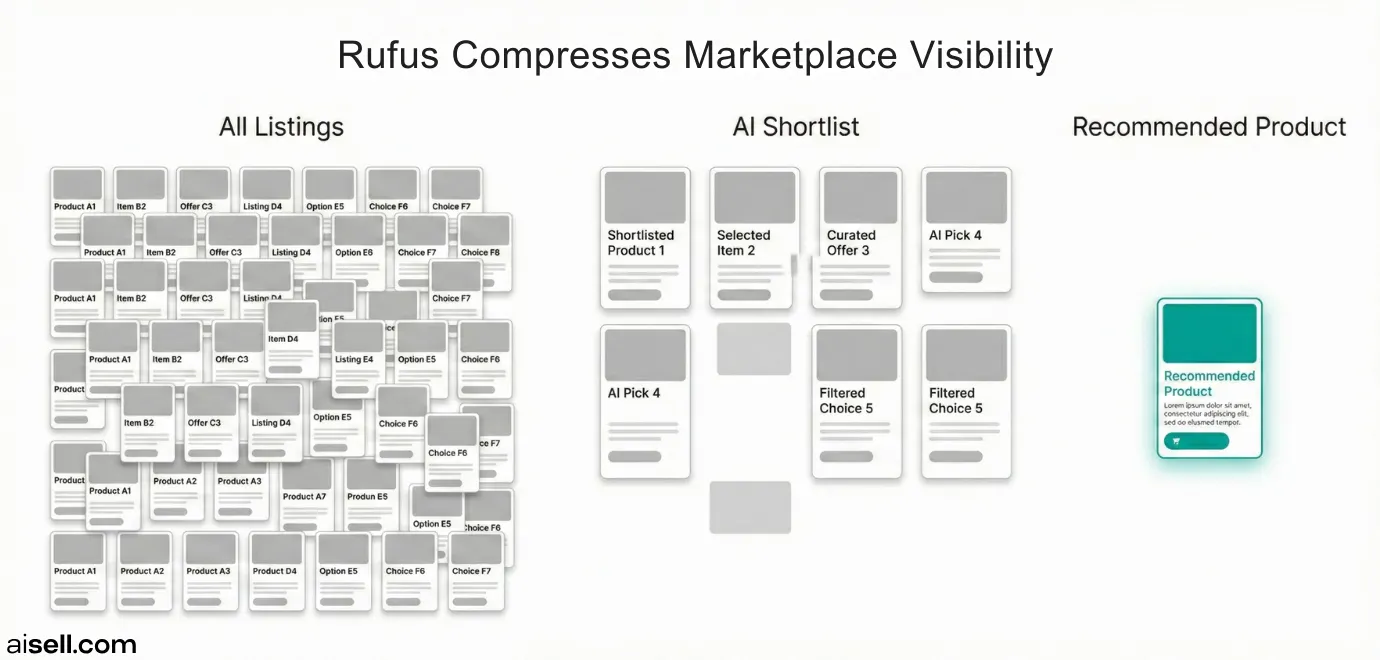
If shoppers use Rufus instead of browsing, fewer people will scroll through pages of results. This means fewer impressions for sellers who rely on classic ranking visibility.
The main impact is not that rankings disappear.
The impact is that shortlists become the new results page.

How Rufus Changes Product Discovery on Amazon
Amazon search has always been based on:
- keyword relevance
- sales velocity
- conversion rate
- CTR
- price competitiveness
- reviews
- fulfillment performance
Rufus introduces a new discovery path.
Instead of showing 50 options, Rufus can surface 3 to 5.
Instead of letting users compare manually, Rufus summarizes trade-offs.
Instead of browsing multiple listings, the customer receives a guided decision.
This shifts visibility from ranking position to selection confidence.
Rufus Does Not Rank Pages, It Selects Products
Classic Amazon search ranks products.
Rufus selects products.
That difference is critical.
Ranking systems are designed for humans to browse. Selection systems are designed for AI to recommend.
This means Amazon sellers must think differently.
The new question is not only:
“How do I rank higher?”
It becomes:
“How do I become the safest recommendation?”
Rufus Favors Products That Reduce Uncertainty
AI systems avoid uncertainty. Rufus will likely prioritize products that are easier to explain and easier to justify.
That means products with:
- complete attributes
- clear compatibility information
- consistent variants
- strong review sentiment
- predictable pricing and stock
- low return risk
If your listing creates confusion, Rufus will avoid it.
What Rufus Uses to Understand Your Product
Rufus cannot recommend what it cannot interpret.
This is why the most important seller assets in 2026 are not ads or keyword tricks.
The most important assets are structure and clarity.
1. Listing Content
Your title, bullets, and description are still critical.
But the goal changes.
You are no longer writing only for customers. You are writing for an AI system that must summarize your product correctly.
If your copy is vague, Rufus will generate vague answers.
If your copy is inconsistent, Rufus will create inconsistent summaries.
2. Structured Attributes
Attributes are one of the strongest AI signals.
If you do not provide structured information, Rufus has nothing reliable to compare.
This is why attribute completeness is becoming a visibility requirement, not a nice-to-have.
3. Reviews and Sentiment Patterns
Rufus likely extracts themes from reviews.
It does not only care about star rating. It cares about patterns:
- what customers praise
- what customers complain about
- whether complaints are repeated
- whether expectations are consistently met
A product with many reviews mentioning the same flaw becomes harder to recommend.
4. Variant Structure and Product Relationships
If your variation structure is messy, Rufus will struggle to explain differences between options.
This can reduce your chance of being included in a shortlist.
Clean variations increase AI confidence.
What Amazon Sellers Should Do Now
Rufus is not a future trend. It is already shaping Amazon’s interface.
Sellers should treat Rufus as a new marketplace environment.
Step 1: Audit Your Listing Clarity
Ask yourself:
- can the product be described in one sentence
- is the use case obvious
- is differentiation clear
If not, Rufus will struggle to position the product correctly.
Step 2: Improve Attribute Completeness
Attributes should be treated as your core AI visibility layer.
Make sure:
- key attributes are filled across all variations
- attribute values are consistent
- compatibility data is included where relevant
Missing attributes equal missing visibility.
Step 3: Fix Variations and Catalog Hygiene
Many Amazon sellers have duplicate ASINs and messy variations due to years of experimentation.
In the AI era, catalog cleanliness matters.
Consolidate variants.
Remove duplicates.
Standardize naming.
Step 4: Review Strategy Becomes AI Strategy
Reviews are not just for conversion.
They are signals that Rufus uses to generate recommendations.
Sellers should focus on:
- reducing recurring complaints
- improving packaging and expectation alignment
- increasing review consistency
- improving long-term product quality
Step 5: Reduce Return Risk
Products with high return risk become harder to recommend.
Return reduction is now part of AI visibility.
This includes:
- clearer sizing information
- better product images
- more accurate descriptions
- quality control improvements
Rufus Will Change PPC and Sponsored Ads Too
Rufus does not remove ads, but it changes how ads compete.
If shoppers rely on AI shortlists, ad placement becomes less powerful as a visibility guarantee.
Sponsored products may still appear, but Rufus-driven decisions will shape what customers consider “best”.
This means sellers should stop thinking of ads as the only lever.
Ads can create initial traction.
But structured data and trust create long-term selection.
The strongest sellers will combine:
- paid growth
- listing clarity
- review strategy
- data completeness
The Rufus Era Checklist for Amazon Sellers
If you want a short checklist, here it is.
To stay visible in the Rufus era, Amazon sellers should prioritize:
- clear product titles and differentiation
- complete structured attributes
- clean variation structures
- review sentiment consistency
- low return risk
- stable pricing and inventory
- high trust signals
- AI-readable catalog structure
Sellers who treat Rufus like “just another feature” will lose visibility over time.
Sellers who treat Rufus like a new discovery layer will gain an advantage.
Key Takeaways
Amazon Rufus is a major shift in marketplace discovery.
It reduces browsing and increases AI-driven selection.
This makes structured product data, trust signals, and operational reliability more important than keyword hacks.
In 2026, the winners on Amazon will not be the best keyword optimizers.
They will be the products Rufus can confidently recommend.