

Why AI Will Break Marketplace Rankings First
The next major shift in marketplace selling will not come from a new algorithm update. It will come from AI-driven product selection.
Marketplaces have always been driven by rankings. On Amazon, Walmart, Allegro, or Etsy, visibility is not a branding problem. It is a ranking problem. If your product does not appear high enough, it effectively does not exist.
For years, sellers learned how to work within this system. They optimized keywords, conversion rate, reviews, price, velocity, and advertising performance. Entire businesses were built around understanding marketplace ranking algorithms.
AI will change this dynamic faster on marketplaces than anywhere else in eCommerce. Not because marketplaces are weak, but because they are already structured, centralized, and perfectly positioned for AI-driven shopping experiences.
This article explains why marketplaces will be disrupted first, what will break, and what sellers should focus on in 2026.
Marketplaces Are Ranking Machines
Marketplaces are not stores in the traditional sense. They are discovery engines.
On a typical marketplace, sellers compete primarily through:
- search position
- category rankings
- buy box access
- sponsored placements
- review volume and velocity
The interface encourages constant comparison. Dozens of products appear on the screen, sorted by relevance or popularity. Sellers fight to be seen within that list.
This system works only as long as users are willing to browse.
Once browsing decreases, rankings lose their power.
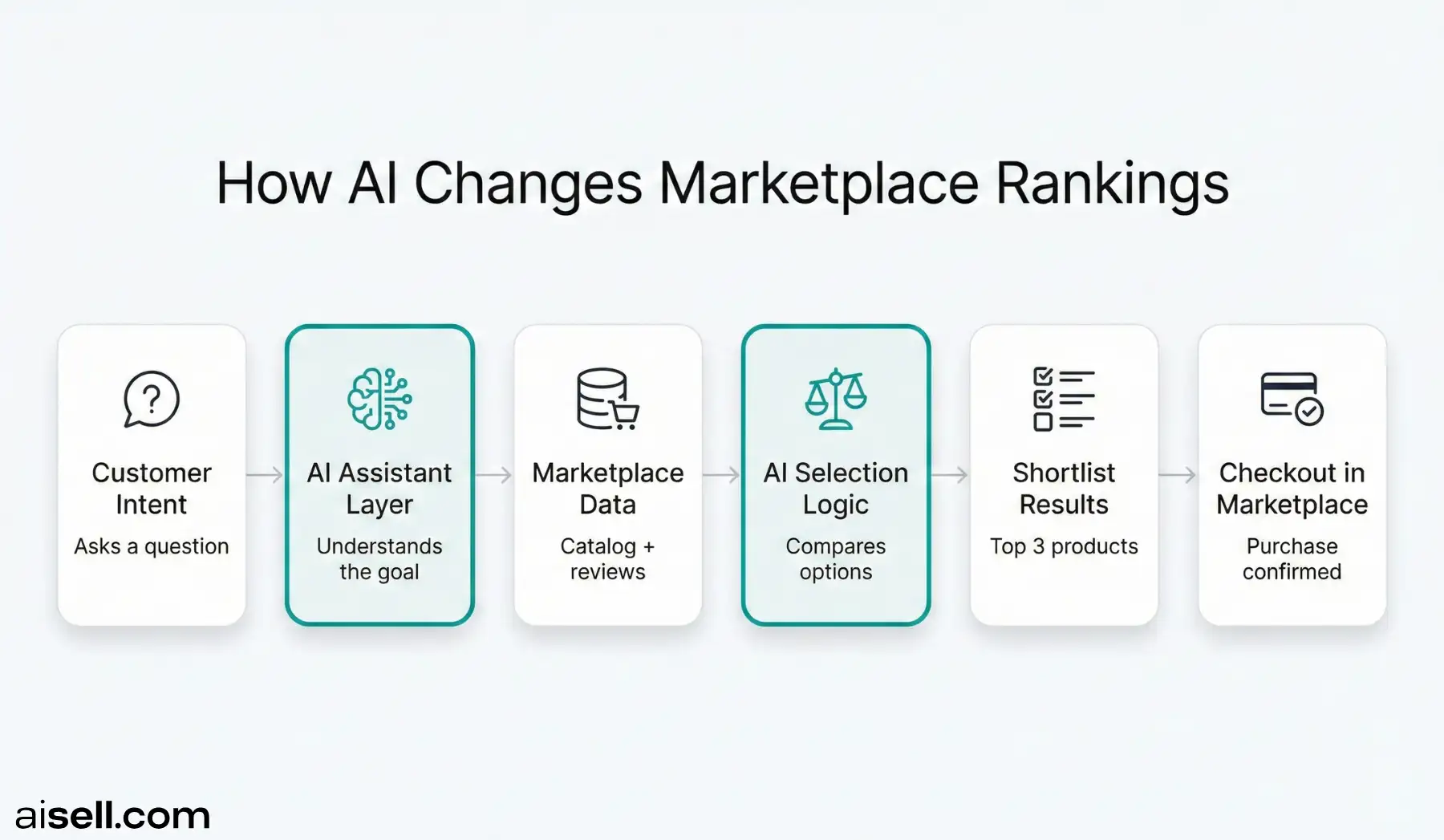
AI does not browse. AI selects.
Rankings Exist Because Humans Compare
Classic marketplace rankings exist to help humans make decisions. They reduce cognitive load by narrowing options and surfacing popular products.
But this still requires effort. Users scroll, filter, open listings, read reviews, compare prices, and make trade-offs manually.
AI removes most of this work.
When a shopper asks a question instead of typing a keyword, the ranking list becomes less relevant. The AI does not need 40 options. It needs enough information to confidently recommend one or two products.
That is the first crack in the ranking system.

Why Marketplaces Will Change Before Google SEO
AI will impact the open web, but marketplaces will change faster.
The reason is simple. Marketplaces already control everything AI needs.
They have:
- structured product catalogs
- real-time pricing and inventory
- reviews and behavioral data
- fulfillment and delivery signals
- return and refund history
- trust and compliance frameworks
From an AI perspective, marketplaces are clean environments. Websites are not.
A marketplace can insert an AI layer directly into the buying journey without asking users to change platforms or habits.
Marketplaces Can Deploy AI Instantly
Google needs adoption. Marketplaces do not.
Amazon can introduce an AI assistant inside search results, product pages, or category views overnight. The user is already there. The data is already there. The checkout is already there.
This makes marketplaces the easiest place to deploy AI-driven discovery.
Once that happens, classic ranking signals stop behaving the way sellers expect.
From Ranking to Selection
Traditional marketplace algorithms decide which products appear higher.
AI-driven systems decide which products appear at all.
This is a fundamental difference.
A product can have good sales velocity and still be excluded if the AI cannot confidently explain why it is the right match for a specific request.
Visibility becomes selection-based, not position-based.
AI Ranking Is Confidence-Based, Not Keyword-Based
Marketplace SEO today still depends heavily on keyword relevance. Titles, bullet points, backend terms. Sellers optimize for indexing and match.
AI systems work differently.
They evaluate confidence.
Confidence comes from clarity, not repetition.
AI looks for products that are:
- clearly defined
- easy to compare
- consistent across attributes
- supported by reviews and policies
- predictable in pricing and availability
If a product creates uncertainty, the AI avoids it.
This breaks many classic seller tactics.
Repeating keywords does not help if the listing does not clearly explain what the product is.
Incomplete variations do not help if the AI cannot match size, compatibility, or use case.
Why This Will Hurt Marketplace Sellers First
Marketplace sellers are more exposed to this shift than DTC brands.
They do not own the interface.
They do not control discovery.
They rely on ranking mechanics they cannot see.
When AI changes how discovery works, sellers cannot opt out.
They can only adapt.
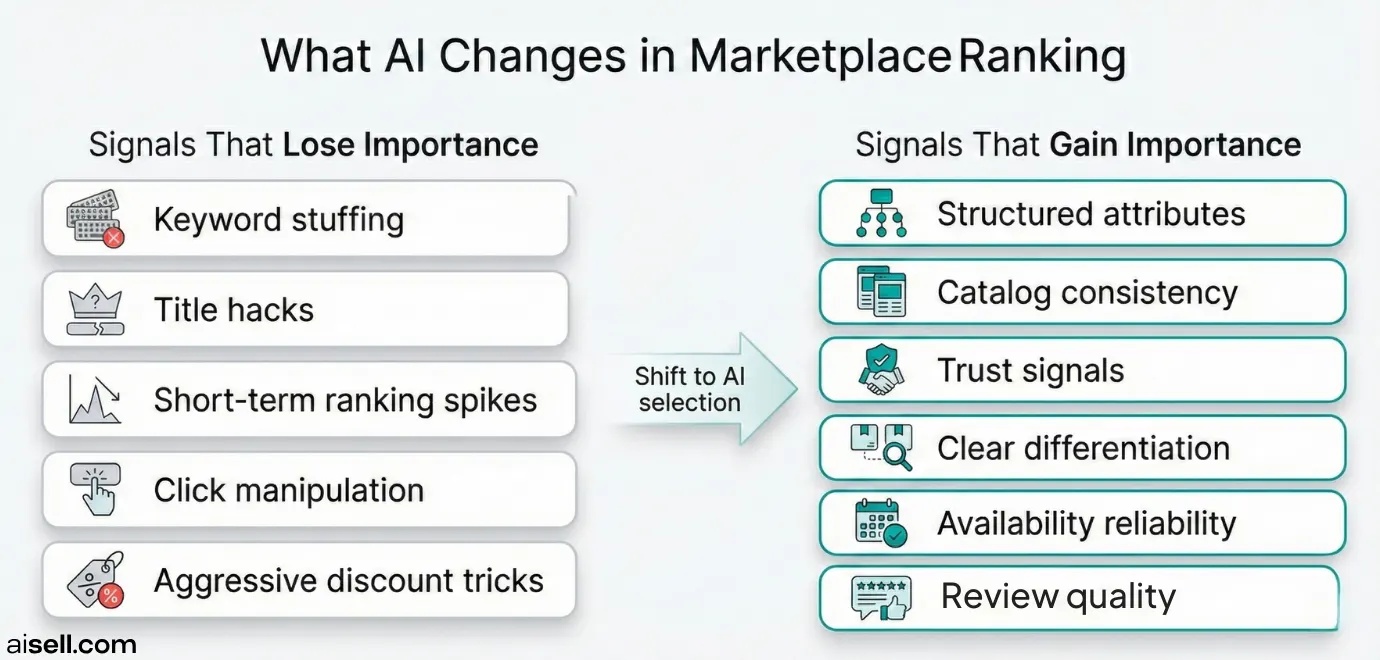
Many sellers optimized for:
- keyword density
- review velocity
- aggressive pricing
- short-term ranking spikes
AI rewards something else entirely.
It rewards predictability.
Predictability Becomes the New Advantage
In AI-driven marketplaces, the best-performing products will often be the least ambiguous ones.
Products with:
- consistent naming
- complete attribute sets
- clear differentiation
- stable pricing
- reliable fulfillment
This shifts the competitive advantage away from hacks and toward structure.
Sellers who invested in clean catalogs will outperform sellers who invested only in ranking tricks.
What Marketplace Sellers Should Do in 2026
Marketplace sellers should not wait for AI features to become dominant before acting.
The changes are gradual, but they compound.
Key priorities for sellers in 2026 include:
- cleaning up product data across all listings
- standardizing variations and attributes
- improving compatibility and specification clarity
- focusing on review quality, not just volume
- reducing pricing and availability inconsistencies
These are not new problems. AI simply makes them impossible to ignore.
AI Does Not Replace Marketplaces, It Rewrites Them
AI will not eliminate marketplaces.
It will rewrite how power flows inside them.
Rankings will matter less.
Selection will matter more.
Sellers who understand this early can position themselves ahead of the curve.
Those who continue optimizing only for classic ranking signals will experience declining visibility without understanding why.
Key Takeaways
Marketplaces will be disrupted by AI before traditional SEO because they already control structured commerce data.
AI-driven discovery shifts visibility from ranking position to selection confidence.
Marketplace sellers must focus on product clarity, structured attributes, and trust signals, not just keywords.
The future of marketplace success is not about gaming algorithms. It is about being understandable to machines.