

What Is AI Commerce?
AI commerce is the shift from traditional eCommerce toward shopping experiences shaped by artificial intelligence. Instead of customers browsing products manually, AI systems increasingly decide what gets discovered, recommended, compared, and purchased.
This change is happening because AI is now built into the tools people use every day: Google, Amazon, Shopify, and assistants like ChatGPT, Gemini, Claude, and Alexa. Product discovery is becoming less about typing keywords and more about asking questions and receiving curated answers.
AI commerce is not one platform or one feature.
It’s an ecosystem where ranking, visibility, and conversion are influenced by AI-powered search, recommendation engines, and autonomous shopping agents.
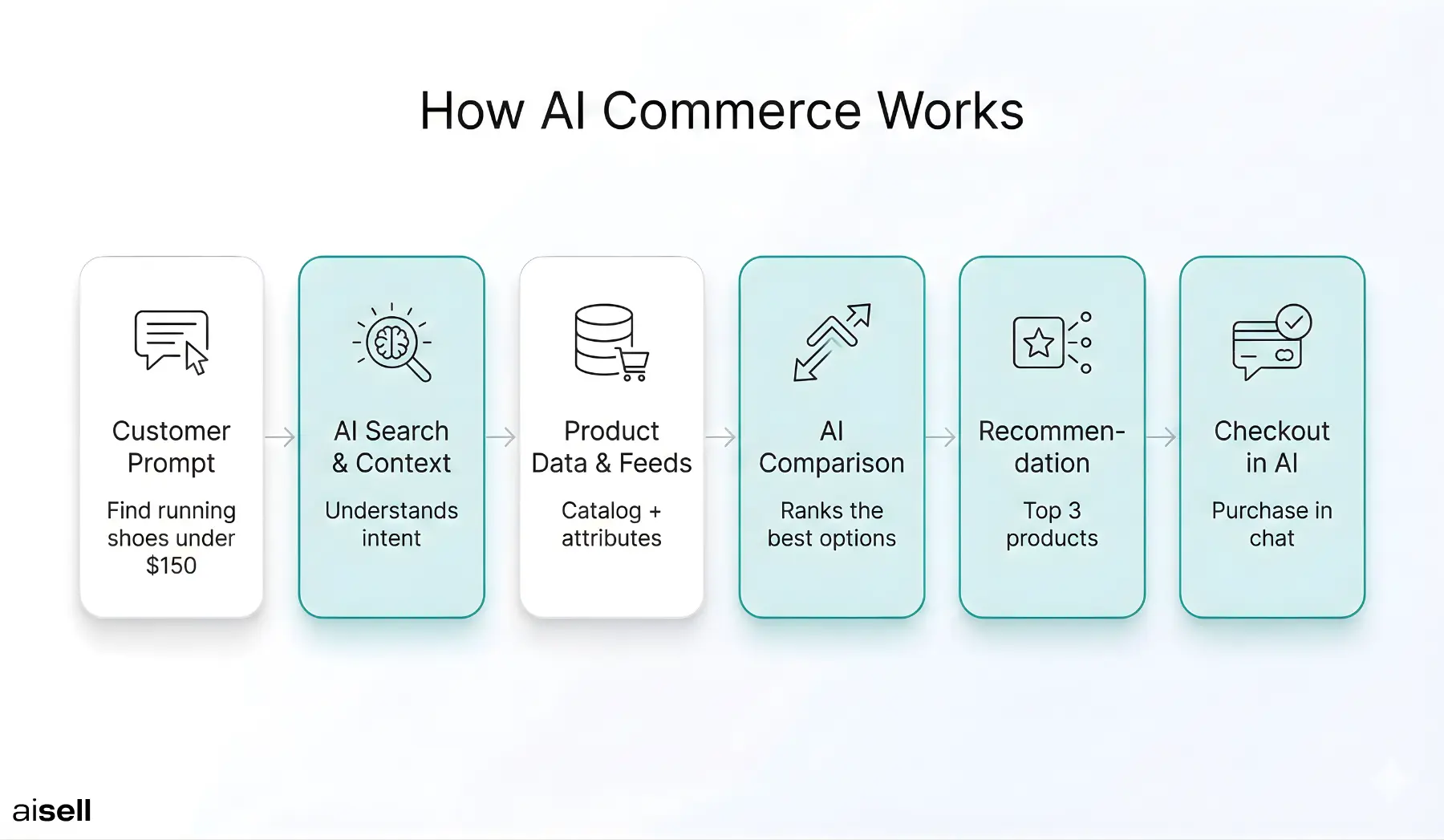
How AI Commerce Works
AI commerce works by translating user intent into product selection.
A shopper describes what they want, and the AI system tries to identify the best match based on product attributes, relevance, and trust signals.
In classic eCommerce, shoppers might browse 50 products.
In AI commerce, the shopper might only see 3–5 recommendations.
That means brands compete for something new:
Not for traffic. Not for clicks. For selection.
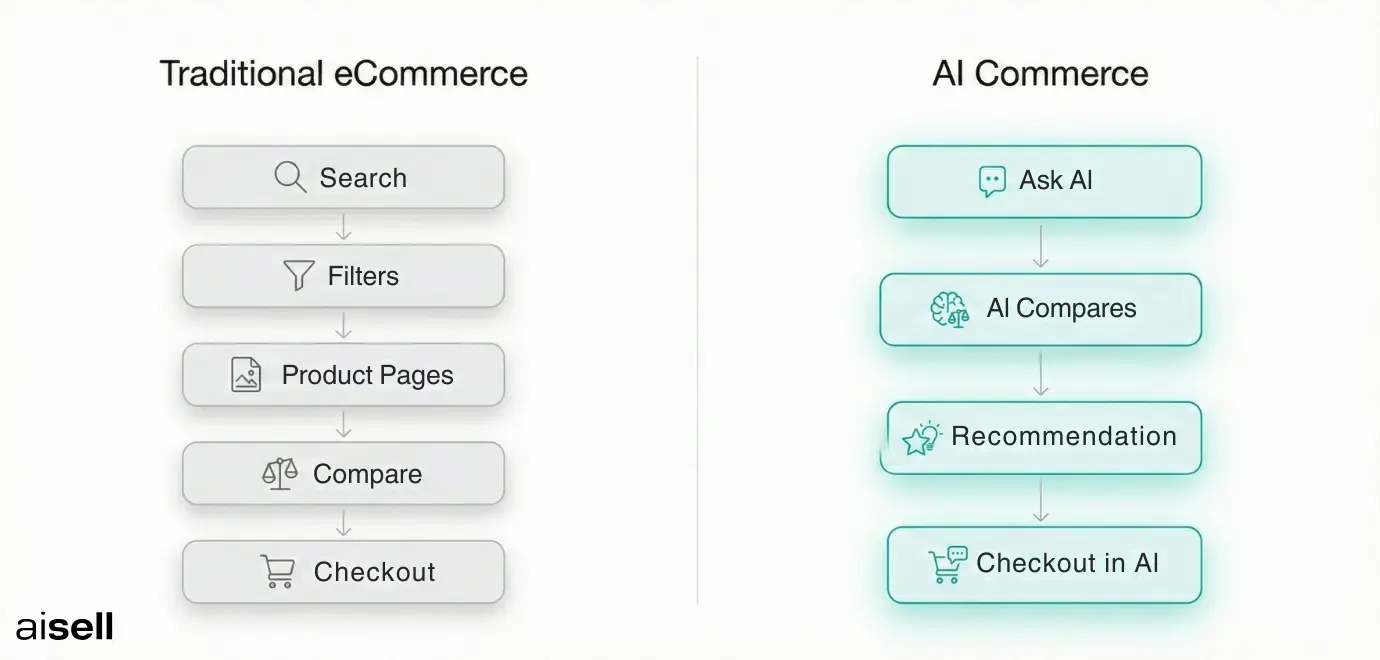
AI Commerce vs Traditional eCommerce
Traditional eCommerce is built around category pages, filters, and keyword search. Customers do the work: they compare products, open tabs, read reviews, and decide.
AI commerce shifts that work to the machine.
The AI compares products, summarizes information, and highlights the best option based on the user’s needs.
This is the key difference:
In AI commerce, your product must be easy to understand not only for humans — but also for machines.
What Is Agentic Shopping?
Agentic shopping is one of the most important concepts in AI commerce.
It describes a shopping experience where an AI agent can complete multiple steps of the buying process on behalf of the customer.
Instead of a user browsing manually, the user delegates the task to an AI system.
The agent then:
- finds products
- compares options
- checks constraints
- recommends the best choice
Chatbot vs Agent?
A chatbot answers questions.
An agent takes action.
How Shopping Agents Work in Real Life
A shopper might ask:
“I need a lightweight carry-on suitcase under $200, available in Europe, with strong reviews.”
A shopping agent can interpret this request, search for options, filter by size and availability, compare features, and return a shortlist.
In advanced cases, agents can also check compatibility, for example:
- printer ink
- laptop chargers
- phone cases
- skincare routines
- supplements
That’s where AI commerce becomes powerful.
It removes friction and kills decision fatigue.
Why Agentic Commerce Changes Product Discovery
In classic eCommerce, visibility is about ranking in search results.
In agentic commerce, visibility is about being selected as the best answer.
If the AI cannot confidently evaluate your product, it will recommend something else.
This creates a new advantage:
Brands with structured and consistent catalogs become easier to recommend than brands with messy product data.
AI Search vs Traditional Search
Traditional search is keyword-based. Users type a phrase like “best running shoes,” and the search engine returns a list of pages.
AI search is intent-based.
Users describe what they want, and the AI tries to provide a direct answer — often including product recommendations.
Instead of giving users hundreds of links, AI search gives:
- a shortlist of products
- summarized pros and cons
- a decision-ready recommendation
It feels less like searching and more like asking.
What AI Search Prioritizes
AI search systems rely on signals that make products easy to interpret.
That means your catalog must be readable not only by people — but also by algorithms.
The biggest factors include:
- Clear product titles and naming conventions
- Consistent taxonomy and category structure
- Accurate product attributes (size, material, compatibility)
- Reliable pricing and stock availability
- Trust signals (reviews, policies, brand consistency)
- Clean product feeds and structured data
AI search is less forgiving than human shoppers.
If data is incomplete, the AI often skips the product instead of guessing.
What AI Commerce Changes for Brands
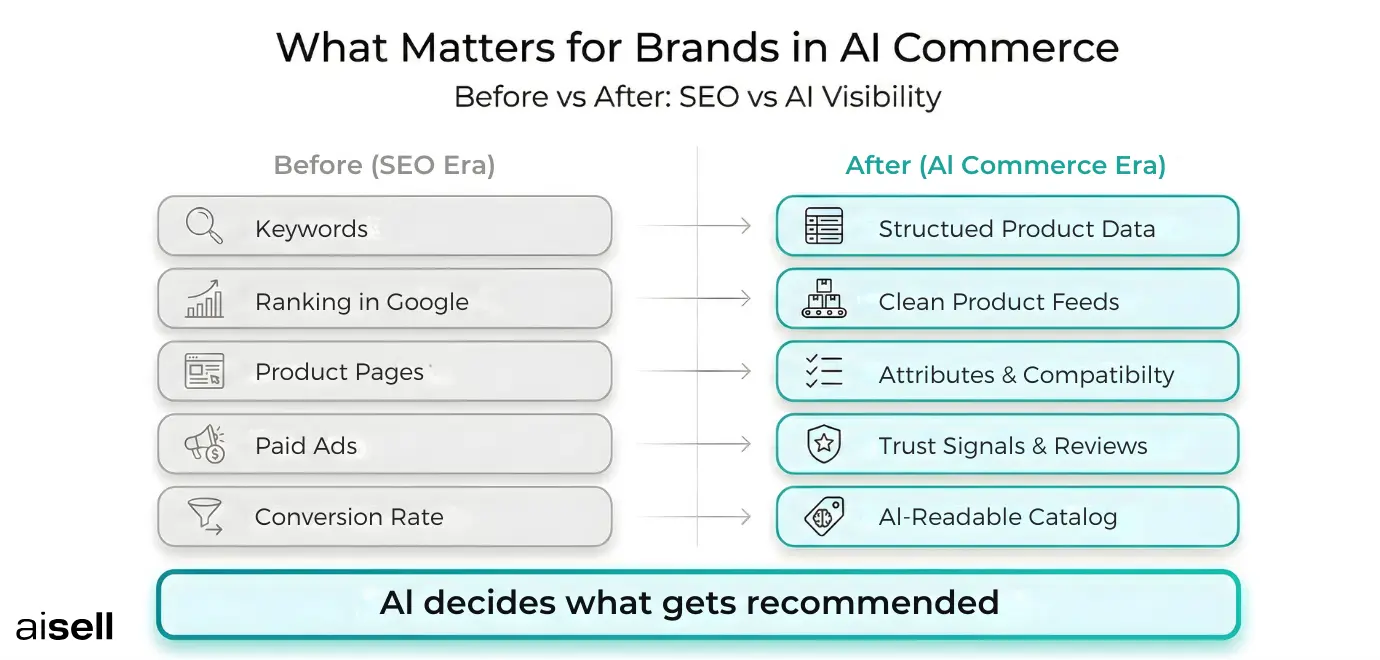
AI commerce shifts competitive advantage from “who has the best website” to who has the best product data.
Brands that win in AI commerce are not necessarily the ones with the best design.
They are the ones with:
- clean catalog structure
- complete product attributes
- consistent naming
- reliable availability
If AI agents cannot compare your products, they cannot recommend them.
And if they cannot trust your data, they will avoid you entirely.
AI Commerce Checklist (AI Readiness)
Most brands don’t need to build an AI agent to prepare for AI commerce.
They need to make their product catalog structured, consistent, and machine-readable.
Here is a practical checklist:
- Audit your catalog for missing attributes and inconsistent variants
- Standardize naming across titles, variants, and collections
- Improve taxonomy so products are categorized logically
- Optimize product feeds for Google, Meta, and marketplaces
- Ensure stock updates are frequent and accurate
- Add compatibility and specification data wherever relevant
- Write product descriptions that answer real buyer questions
- Strengthen trust signals such as reviews, warranties, and returns
These improvements increase the chance that AI systems will prioritize your products during discovery.
The Future of eCommerce Visibility
AI commerce is not a trend that will arrive someday.
It is already shaping how people shop.
The difference is that most brands are still optimizing for classic SEO and classic browsing behavior.
The next era of eCommerce is about being recommended by machines before a customer even visits your store.
Brands that adapt early will win visibility in:
- AI search engines
- shopping agents
- AI-driven recommendation platforms
Key Takeaways
AI commerce is the shift toward AI-driven product discovery, recommendation, and decision-making.
Agentic shopping is the next evolution, where AI agents handle multi-step shopping tasks.
AI search changes visibility rules by prioritizing structured data, trust, and clarity over keyword SEO alone.
The most important step is simple:
Make your catalog clean, structured, and easy for AI systems to interpret.