


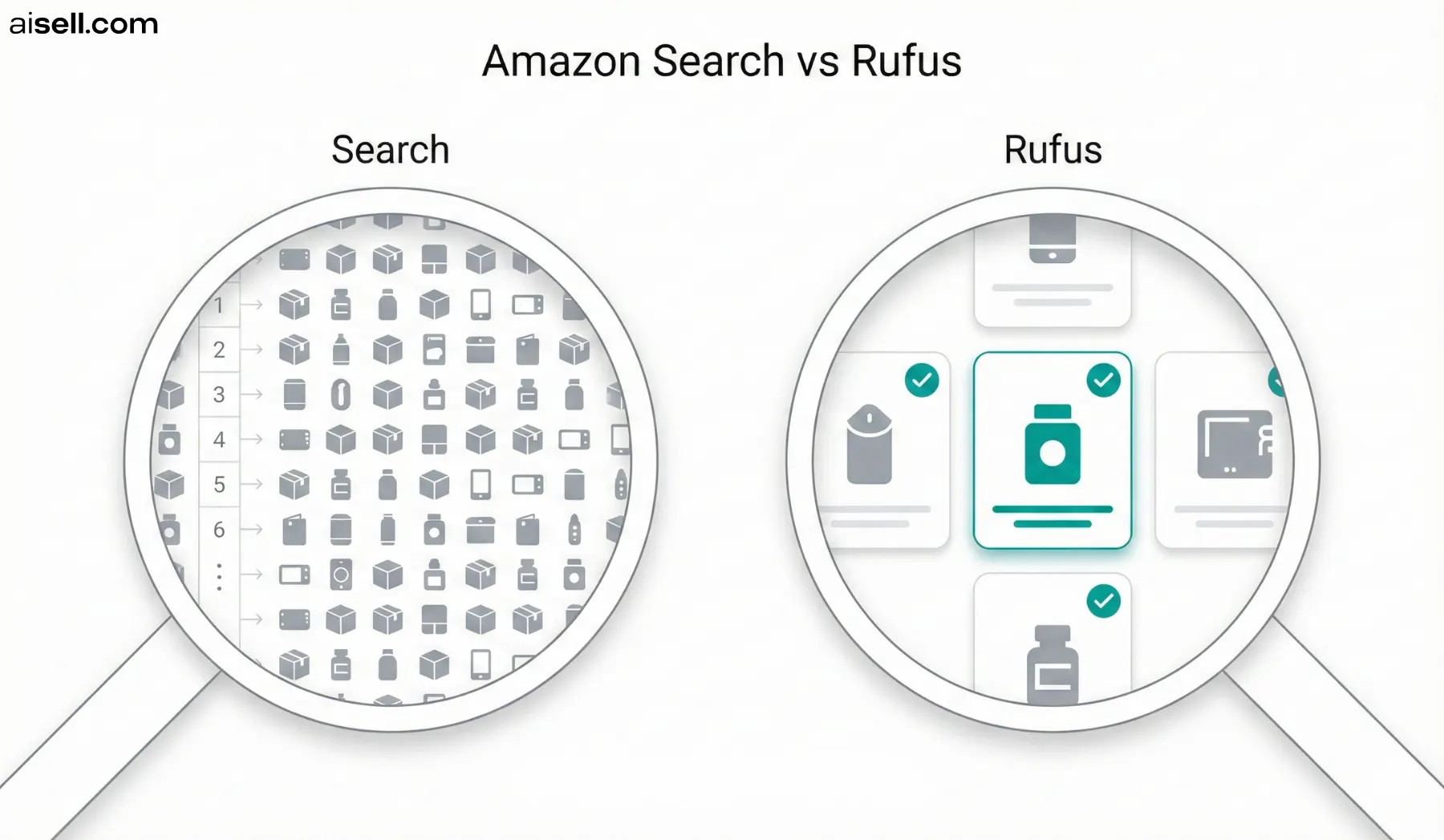
Amazon Search vs Rufus: Two Very Different Systems
Amazon Search and Amazon Rufus solve different problems.
Amazon Search was built to handle discovery at scale. Millions of products. Billions of searches. The goal was to surface relevant results and let users decide.
Rufus is built to handle decision fatigue. Too many choices. Too much uncertainty. Too much comparison.
That difference alone explains why Rufus behaves differently.
How Classic Amazon Search Works
Traditional Amazon search relies on:
- keyword relevance
- sales velocity
- conversion rate
- click behavior
- pricing competitiveness
- reviews
- fulfillment performance
These signals determine ranking.
The assumption behind this system is simple.
The user will browse.
That assumption shaped everything sellers optimized for:
- keyword density
- indexing coverage
- ranking position
- page one visibility
Ranking mattered because visibility came from scrolling.
How Rufus Changes the Core Assumption
Rufus starts from a different assumption.
The user does not want to browse.
Instead of scrolling through pages, the shopper wants a clear answer. A recommendation. A short list.
Rufus is designed to:
- interpret intent
- evaluate options
- reduce uncertainty
- guide the decision
This is not a better search engine.
It is a decision engine.
And decision engines behave differently than ranking systems.
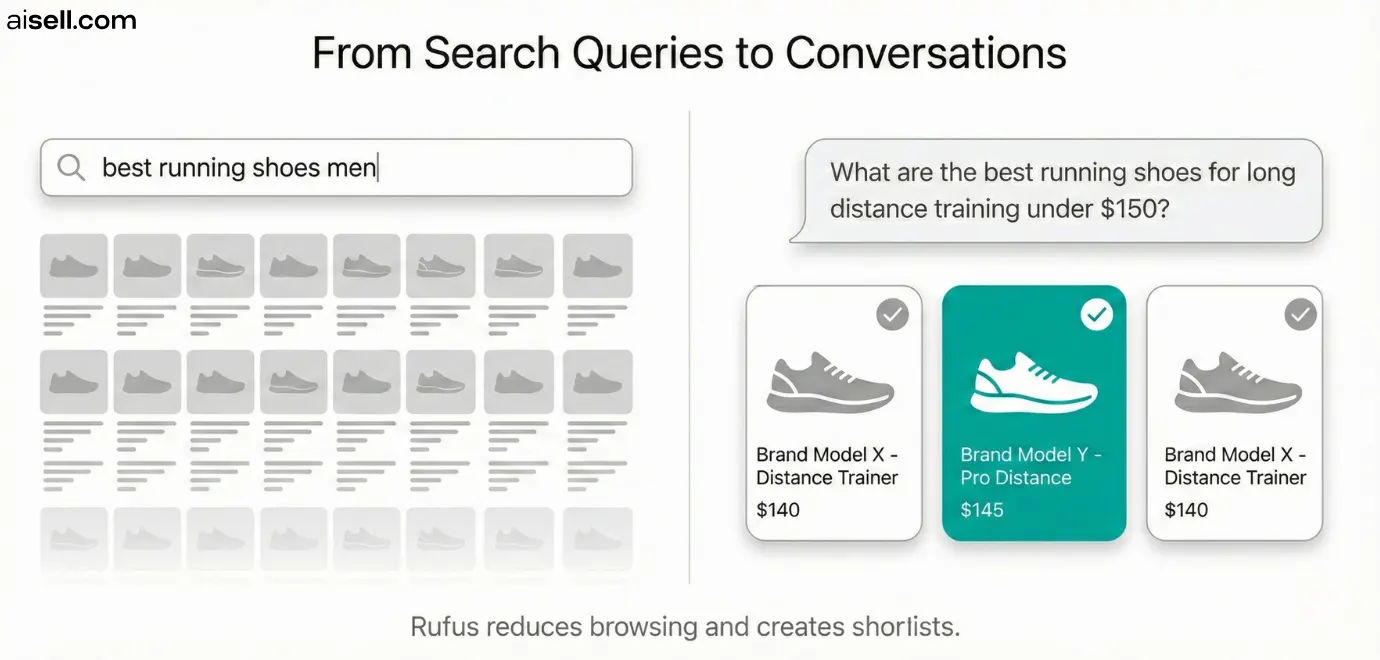
What Changes in Product Discovery
The most important change is not technical.
It is behavioral.
From Browsing to Delegation
With Amazon Search, customers do the work:
- scan results
- open listings
- compare features
- read reviews
- make trade offs
With Rufus, customers delegate that work.
They ask:
- which option is best
- which one fits their use case
- what other buyers say
- what they should avoid
Rufus performs the comparison and presents conclusions.
This reduces the number of products a customer ever sees.
Visibility Becomes Binary
In classic search, visibility is gradual.
Page one is better than page two.
Top three is better than bottom ten.
With Rufus, visibility becomes binary.
A product is either:
- considered by the AI
- or ignored
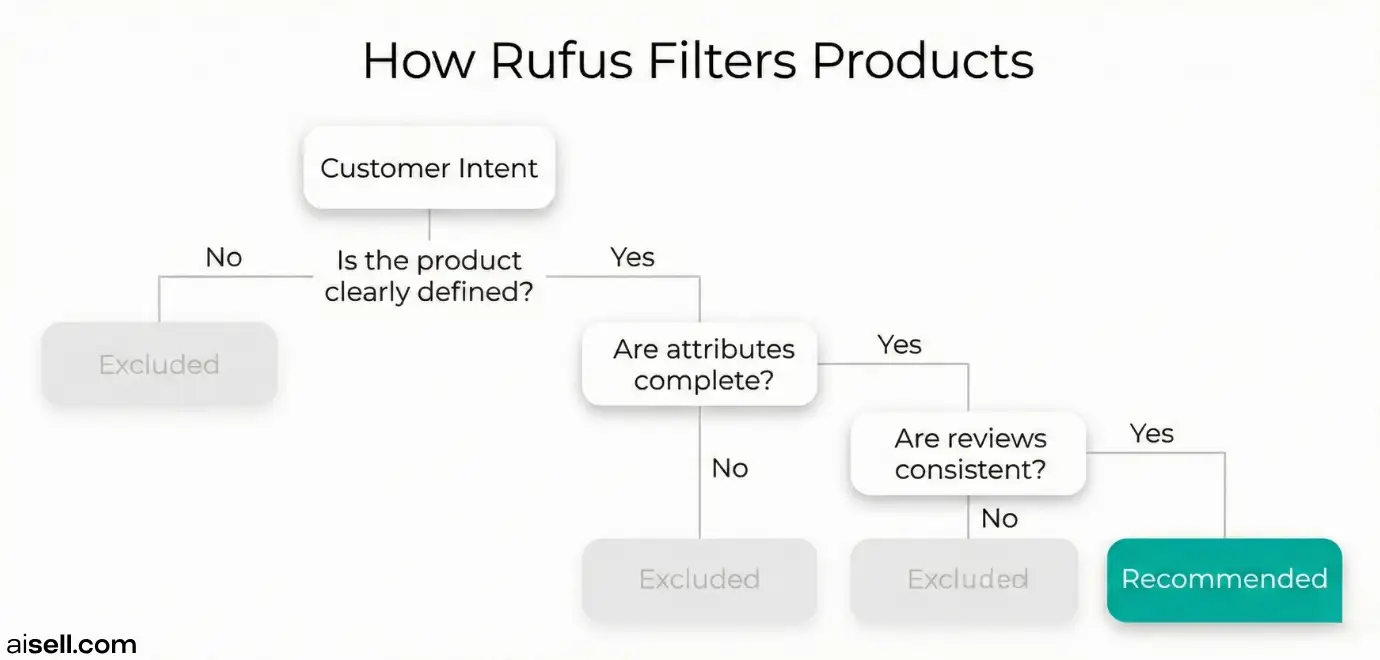
If Rufus cannot confidently evaluate a product, it never enters the conversation.
That is a radical shift.
Rankings Still Exist but Matter Less
This does not mean Amazon Search disappears.
Rankings still exist in the background.
Ads still appear.
Categories still function.
But behavioral gravity shifts.
If customers trust Rufus, they stop browsing.
When browsing stops, ranking loses influence.
How Rufus Evaluates Listings Differently Than Search
Amazon Search matches keywords.
Rufus evaluates confidence.
This is the most important difference sellers must understand.
Search Optimizes for Relevance
Rufus Optimizes for Safety
Search systems are tolerant.
They show many options and let users decide.
Rufus is conservative.
It prefers fewer options that are easier to justify.
Rufus avoids:
- unclear products
- inconsistent data
- messy variations
- contradictory reviews
- unstable pricing
- high return risk
Search might still rank these products.
Rufus will not recommend them.
Structured Data Becomes Critical
Search can work with messy data.
AI cannot.
Rufus relies heavily on:
- structured attributes
- clean variation logic
- consistent product definitions
- compatibility information
If this data is missing, Rufus has nothing reliable to work with.
That means sellers who ignored attributes in the past are now invisible.
Reviews Shift From Social Proof to Evidence
Search uses reviews as ranking signals.
Rufus uses reviews as evidence.
It analyzes:
- recurring complaints
- repeated praise
- sentiment patterns
- expectation mismatches
A product with high stars but consistent complaints becomes risky.
Rufus prefers products with predictable outcomes, not just popularity.
Why Keyword Tricks Stop Working
Keyword stuffing works in ranking systems.
It fails in evaluation systems.
Rufus does not care how many times a phrase appears.
It cares whether the product clearly solves the user’s problem.
Generic listings lose relevance.
Differentiated listings gain confidence.
What Sellers Must Change in 2026
This is the part that matters.
Amazon sellers should stop asking:
“How do I rank higher?”
They should start asking:
“How does Rufus evaluate my product?”
Shift From Optimization to Qualification
In the Rufus era, sellers must qualify for selection.
That means:
- clear product definition
- narrow use case focus
- consistent attributes
- clean variants
- reliable pricing
- stable inventory
- strong review sentiment
If a product creates uncertainty, Rufus avoids it.
Why Generic Products Lose First
Rufus struggles with generic products.
If 20 listings look identical, Rufus cannot justify recommending one over another.
This accelerates commoditization for sellers who did not differentiate.
Differentiation becomes mandatory, not optional.
Ads Do Not Save Unqualified Listings
Sponsored ads can still buy visibility.
But ads do not change evaluation.
If Rufus does not trust a product, ads only increase short term exposure.
Long term visibility depends on AI confidence, not ad spend.
The New Amazon Advantage
The strongest sellers in 2026 will not be the most aggressive optimizers.
They will be the most predictable operators.
Predictable products.
Predictable data.
Predictable outcomes.
That is what AI systems reward.
Key Takeaways
Amazon Search and Amazon Rufus are fundamentally different systems.
Search ranks products.
Rufus evaluates and selects them.
This shifts visibility from ranking position to AI eligibility.
Sellers who optimize for clarity, structure, and trust will be recommended more often.
Sellers who rely on keyword tricks and ranking hacks will slowly disappear from AI driven discovery.
The future of Amazon selling is not about winning search.
It is about being the safest product to recommend.