


AI-powered search is fundamentally changing how people discover products online. Instead of typing keywords, scrolling through results, and comparing dozens of product pages, shoppers increasingly rely on AI systems to understand intent, compare options, and recommend the best product.
This shift affects every part of eCommerce — from SEO and product pages to feeds, catalogs, and conversion strategy. Brands that continue optimizing only for classic search risk losing visibility as AI-driven discovery becomes the default.
This article explains how AI search works, why it changes eCommerce SEO, and what brands must optimize for next.
What Is AI Search in eCommerce?
AI search refers to search experiences where artificial intelligence interprets user intent and returns curated answers or recommendations, rather than a ranked list of links.
In eCommerce, this means shoppers are no longer browsing results pages. They are asking questions and receiving decisions.
Examples already shaping AI-driven product discovery include:
- ChatGPT shopping experiences
- Gemini-powered Google results
- Marketplace recommendation engines
- Voice assistants like Alexa
AI search prioritizes meaning, context, and confidence, not just keyword matches.
Instead of asking “Which page should rank first?”, AI systems ask:
“Which product best satisfies this request?”
How AI Search Differs From Traditional eCommerce SEO
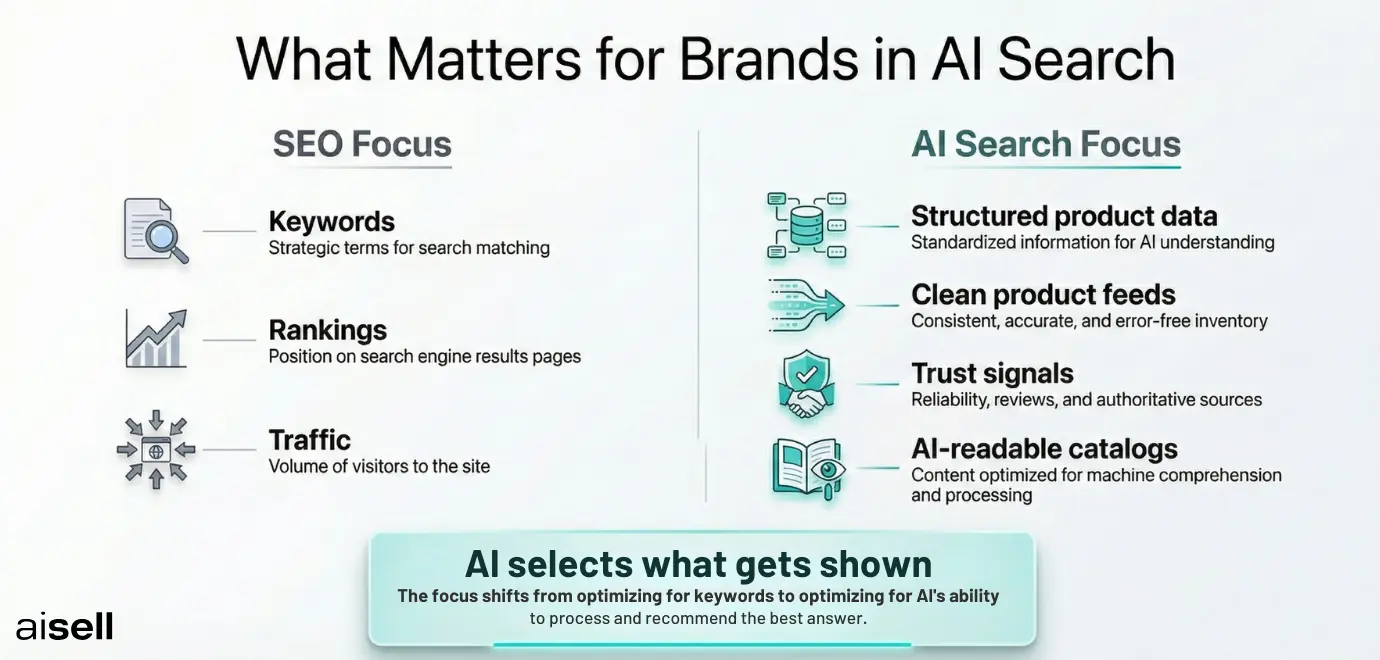
Traditional eCommerce SEO is built around keywords, rankings, and traffic. A shopper types a query, and the search engine returns pages based on relevance and authority.
AI search works differently.
The system first tries to understand intent, then evaluates products based on available data, constraints, and trust signals.
Key differences include:
- Fewer results shown to the user
- More decision-making done by the system
- Higher importance of product data quality
- Less tolerance for incomplete information
Instead of ten blue links, users often see one recommendation or a short shortlist.
That means visibility is no longer about ranking position — it’s about being selected.

Why AI Search Changes Product Discovery
AI search changes product discovery because it removes manual browsing from the shopping process.
In classic eCommerce, users:
- search
- filter
- open multiple product pages
- compare options
- decide
In AI-driven discovery, the system performs most of these steps automatically.
The AI:
- interprets the request
- filters products by constraints
- compares attributes
- evaluates reviews and trust signals
- selects the best match
The user’s role shifts from researcher to reviewer.
As a result, most products are never seen at all.
Visibility in AI Search Is Selection-Based
In AI search, visibility is binary.
A product is either:
- selected and recommended, or
- excluded entirely
If an AI system cannot confidently evaluate a product, it will skip it — even if the product ranks well in classic SEO.
Common reasons products get excluded include:
- missing attributes
- inconsistent variants
- unclear descriptions
- unreliable pricing or stock data
- weak trust signals
AI systems are risk-averse. They prefer products they can fully understand and explain.
This is why data clarity matters more than ever.
What AI Search Looks for in Product Data
AI search systems rely heavily on structured and consistent product information.
The most important signals typically include:
- Clear product titles
- Consistent attributes and variants
- Accurate pricing and availability
- Compatibility and specifications
- Reviews and trust signals
- Clean, well-maintained product feeds
Unlike human shoppers, AI systems do not infer or guess.
If the data is incomplete, the product is often excluded before comparison even begins.
Why SEO Alone Is No Longer Enough
Classic SEO is still important — but it is no longer sufficient on its own.
Ranking a product page does not guarantee visibility if AI systems choose not to surface that product in recommendations.
This creates a new optimization layer:
- not just search engine optimization
- but AI visibility optimization
Brands must ensure their catalogs are:
- machine-readable
- comparable
- consistent across channels
This is where AI readiness and audits become critical.
How Brands Can Prepare for AI Search
Preparing for AI search does not require rebuilding your store or launching an AI chatbot.
It requires improving how your product information is structured, maintained, and evaluated.
Key preparation steps include:
- auditing product attributes and variants
- standardizing naming conventions
- improving taxonomy and categorization
- cleaning and enriching product feeds
- ensuring reliable stock and pricing updates
- strengthening reviews and trust signals
These improvements increase the likelihood that AI systems will understand and recommend your products.
AI Search and the Future of eCommerce SEO
As AI search becomes more common, eCommerce SEO will continue to evolve.
Traffic-based thinking will matter less than selection-based visibility.
Brands that adapt early will benefit from:
- higher-quality discovery
- reduced reliance on paid traffic
- stronger positioning in AI-driven shopping experiences
Those that don’t may find their products invisible — even if their SEO looks good on paper.
Key Takeaways
- AI search is replacing keyword-based discovery with intent-based recommendations
- Visibility in AI search depends on being selected, not ranked
- Product data quality is now a core growth lever
- SEO must evolve into AI visibility optimization
- Brands that prepare early gain a long-term advantage