


What Is an AI Commerce Audit?
An AI commerce audit is a structured review of how prepared an eCommerce business is for AI-driven product discovery, recommendation, and decision-making.
Unlike traditional SEO or UX audits, an AI commerce audit looks beyond pages and keywords. It evaluates data quality, system integrations, workflows, and decision logic that AI systems rely on.
The goal is simple:
make your products and operations understandable, comparable, and usable by AI systems.
An AI commerce audit typically covers:
- product data and catalogs
- feeds and integrations
- discovery and recommendation logic
- operational workflows
- automation and tooling opportunities
It answers one core question:
Can AI confidently work with your business — or not?
Why AI Commerce Audits Matter in 2026
AI-driven shopping is no longer experimental.
AI search, shopping agents, recommendation engines, and generative interfaces are already shaping how customers find and choose products.
This creates a new risk for brands:
- your store may function perfectly for humans
- but fail silently for AI systems
If AI cannot interpret your catalog, it cannot recommend your products.
If AI cannot trust your data, it will avoid it.
That is why AI readiness is becoming a competitive advantage.
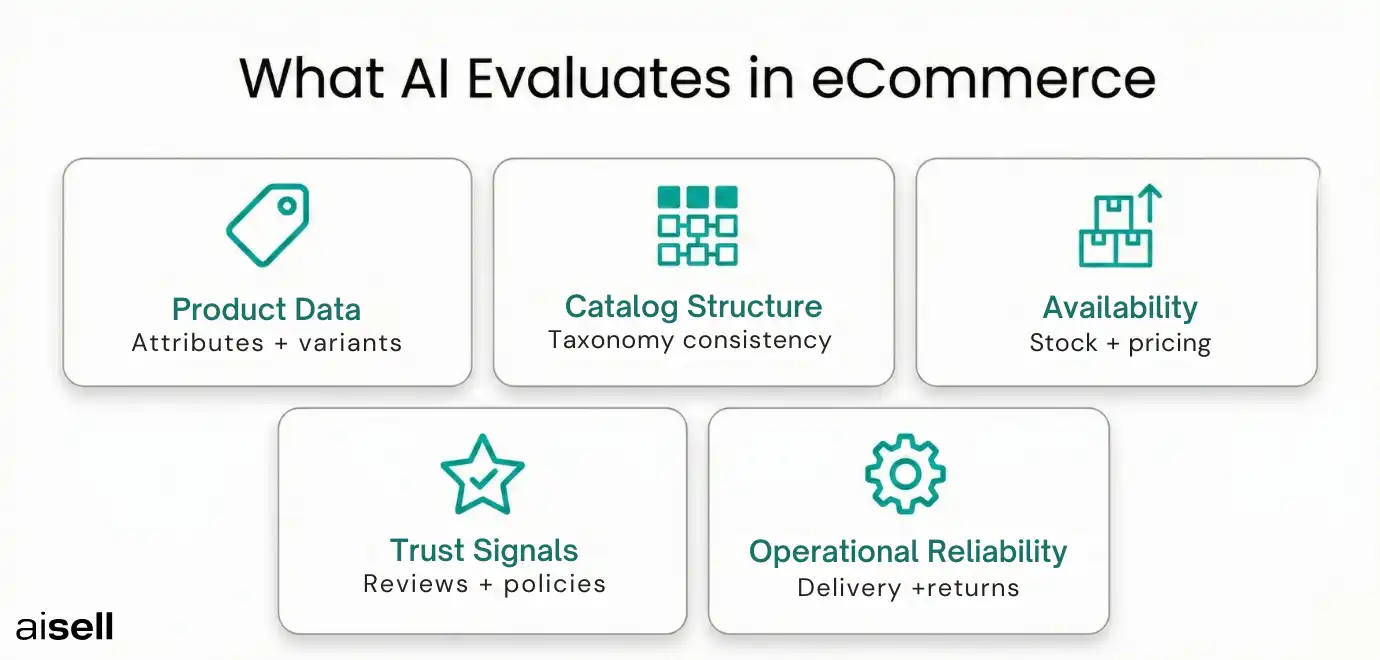
What an AI Commerce Audit Looks At
An AI commerce audit focuses on how machines see your business, not how it looks visually.
Product Data & Catalog Structure
AI systems rely heavily on structured product information.
An audit checks:
- attribute completeness
- variant consistency
- naming conventions
- taxonomy and categorization
- compatibility and specifications
Missing or inconsistent attributes are one of the most common AI visibility blockers.
Feeds, Integrations, and Data Sources
AI systems pull information from multiple sources.
An audit reviews:
- product feeds (Google, Meta, marketplaces)
- update frequency for stock and pricing
- data conflicts between systems
- PIM, ERP, and CMS alignment
Clean feeds are no longer just a marketing requirement — they are an AI requirement.
Discovery & Recommendation Logic
AI-driven discovery depends on logic, not layout.
An audit evaluates:
- how products are filtered and compared
- what signals influence recommendations
- whether important attributes are machine-readable
- how trust signals are surfaced
If AI cannot explain why a product is a good match, it is unlikely to recommend it.
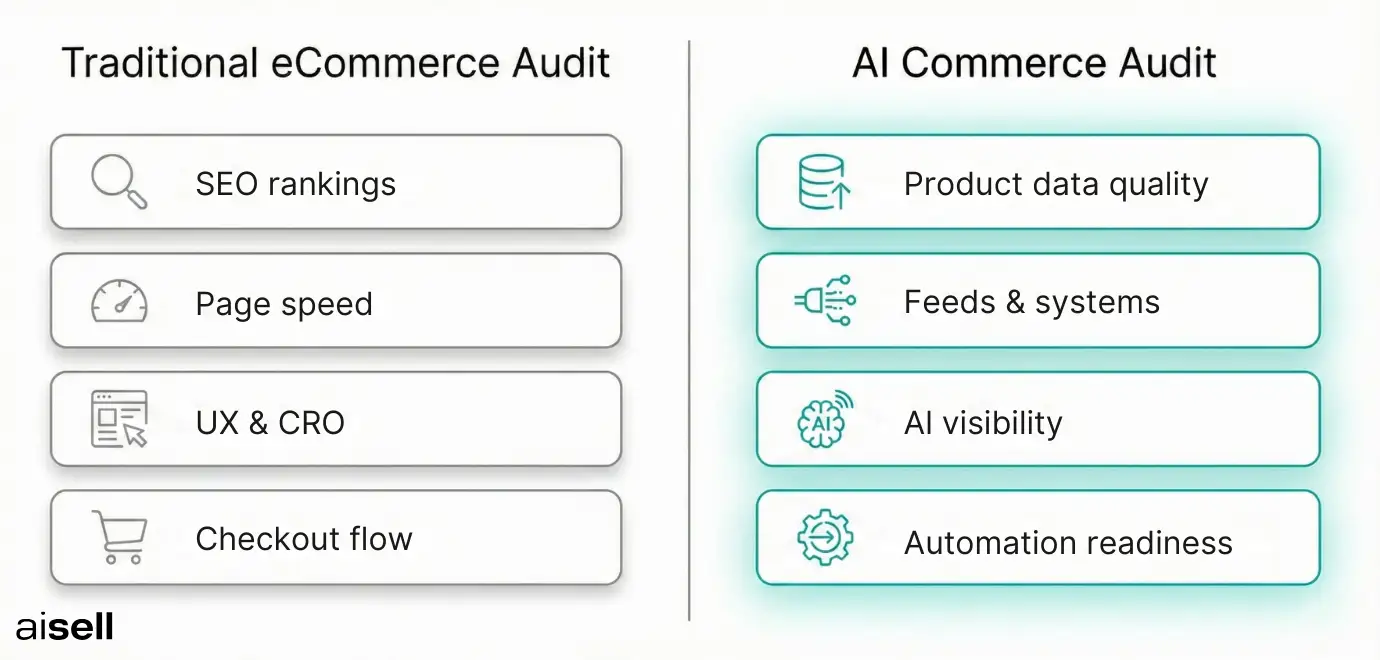
AI Commerce Audit vs Traditional eCommerce Audit
Traditional audits focus on:
- SEO rankings
- page speed
- UX flows
- conversion rate
AI commerce audits focus on:
- machine readability
- decision confidence
- data consistency
- automation readiness
Both are important — but they solve different problems.
Operational Readiness: The Hidden Part of AI Commerce
AI commerce is not only about discovery.
It also affects operations.
AI systems interact with:
- inventory data
- pricing logic
- fulfillment rules
- support workflows
An AI commerce audit often reveals:
- manual processes that block automation
- data bottlenecks between teams
- tools that don’t talk to each other
- decisions that depend on spreadsheets
These are not “AI problems” — they are scaling problems that AI makes visible.
Tooling and Automation Opportunities
A strong AI commerce audit does not just identify problems.
It identifies leverage.
Common outcomes include:
- automation of reporting and analytics
- catalog enrichment workflows
- inventory and demand forecasting improvements
- pricing and margin analysis
- customer support automation
- feed optimization pipelines
The audit becomes a roadmap for practical AI adoption, not experimentation.
Common AI Readiness Gaps in eCommerce
Across brands and marketplaces, the same gaps appear repeatedly:
- incomplete product attributes
- inconsistent variant structures
- outdated feeds
- disconnected tools
- manual operational workflows
- unclear ownership of data quality
These gaps limit visibility in AI-driven shopping long before a brand realizes it.
How to Prepare for an AI Commerce Audit
You don’t need to “do AI” before running an audit.
But you should be ready to look honestly at your setup.
Preparation steps include:
- documenting your product data sources
- listing core tools and integrations
- identifying manual workflows
- clarifying business goals (growth, efficiency, visibility)
The value of an AI commerce audit is not in the report —
it is in the clarity it creates.
AI Commerce Audits as a Strategic Advantage
Brands that audit early gain:
- faster adaptation to AI-driven discovery
- cleaner data foundations
- clearer automation priorities
- reduced operational friction
Brands that wait often react after visibility is already lost.
AI commerce audits are not about prediction.
They are about preparation.
Key Takeaways
- AI commerce audits assess readiness for AI-driven shopping
- They focus on data, systems, and operations — not just SEO
- AI visibility depends on structure, consistency, and trust
- Audits uncover automation and efficiency opportunities
- Early preparation creates long-term advantage